


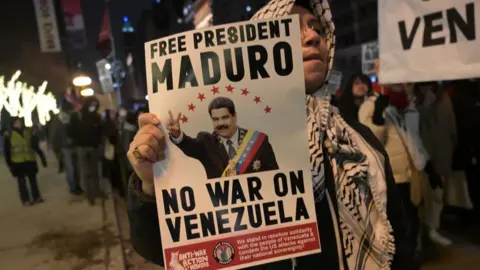
This past Monday, a shackled, jumpsuit-clad Nicholas Maduro disembarked from a military helicopter in Manhattan, accompanied by armed federal agents.
The Caracas chief had spent the night in a infamous federal jail in Brooklyn, before authorities transported him to a Manhattan federal building to confront criminal charges.
The chief law enforcement officer has asserted Maduro was brought to the US to "answer for his alleged crimes".
But legal scholars question the legality of the government's actions, and maintain the US may have infringed upon global treaties governing the military intervention. Under American law, however, the US's actions fall into a legal grey area that may still result in Maduro being tried, despite the events that delivered him.
The US asserts its actions were permissible under statute. The government has alleged Maduro of "narco-trafficking terrorism" and enabling the shipment of "vast amounts" of illicit drugs to the US.
"The entire team acted with utmost professionalism, decisively, and in full compliance with US law and standard procedures," the top legal official said in a statement.
Maduro has long denied US claims that he oversees an criminal narcotics enterprise, and in the federal courthouse in New York on Monday he pled of innocent.
Global Law and Action Concerns
Although the indictments are centered on drugs, the US legal case of Maduro is the culmination of years of condemnation of his rule of Venezuela from the broader global community.
In 2020, UN fact-finders said Maduro's government had perpetrated "serious breaches" amounting to international crimes - and that the president and other senior figures were involved. The US and some of its partners have also alleged Maduro of rigging elections, and withheld recognition of him as the rightful leader.
Maduro's alleged links to criminal syndicates are the centerpiece of this indictment, yet the US tactics in putting him before a US judge to answer these charges are also under scrutiny.
Conducting a covert action in Venezuela and spiriting Maduro out of the country in a clandestine nighttime raid was "a clear violation under international law," said a expert at a law school.
Scholars pointed to a series of concerns presented by the US mission.
The United Nations Charter forbids members from armed aggression against other countries. It allows for "self-defence if an armed attack occurs" but that risk must be looming, experts said. The other exception occurs when the UN Security Council sanctions such an intervention, which the US lacked before it took action in Venezuela.
Treaty law would consider the illicit narcotics allegations the US alleges against Maduro to be a police concern, experts say, not a armed aggression that might permit one country to take military action against another.
In comments to the press, the government has characterised the operation as, in the words of the Secretary of State, "primarily a police action", rather than an hostile military campaign.
Historical Parallels and Domestic Jurisdictional Questions
Maduro has been formally charged on drug trafficking charges in the US since 2020; the federal prosecutors has now issued a updated - or amended - indictment against the Venezuelan leader. The executive branch essentially says it is now enforcing it.
"The mission was conducted to facilitate an ongoing criminal prosecution tied to massive illicit drug trade and associated crimes that have fuelled violence, destabilised the region, and contributed directly to the drug crisis causing fatalities in the US," the AG said in her remarks.
But since the mission, several legal experts have said the US violated international law by extracting Maduro out of Venezuela unilaterally.
"A country cannot enter another independent state and detain individuals," said an authority in international criminal law. "In the event that the US wants to arrest someone in another country, the proper way to do that is extradition."
Regardless of whether an person is accused in America, "America has no right to operate internationally enforcing an arrest warrant in the lands of other independent nations," she said.
Maduro's attorneys in court on Monday said they would contest the lawfulness of the US operation which brought him from Caracas to New York.
There's also a ongoing legal debate about whether heads of state must adhere to the UN Charter. The US Constitution considers accords the country enters to be the "supreme law of the land".
But there's a clear historic example of a presidential administration arguing it did not have to comply with the charter.
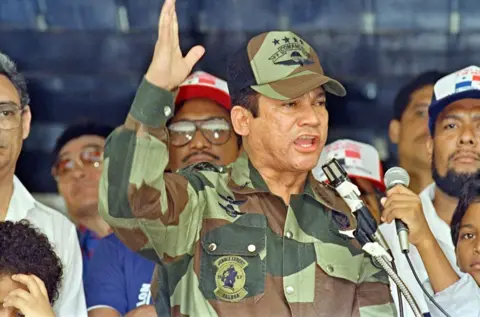
In 1989, the US government ousted Panama's de facto ruler Manuel Noriega and took him to the US to answer narco-trafficking indictments.
An confidential Justice Department memo from the time contended that the president had the executive right to order the FBI to arrest individuals who flouted US law, "regardless of whether those actions breach customary international law" - including the UN Charter.
The author of that document, William Barr, became the US top prosecutor and issued the initial 2020 indictment against Maduro.
However, the document's logic later came under questioning from academics. US courts have not made a definitive judgment on the question.
US War Powers and Legal Control
In the US, the issue of whether this action violated any US statutes is complex.
The US Constitution grants Congress the prerogative to commence hostilities, but puts the president in control of the armed forces.
A War Powers Resolution called the War Powers Resolution imposes restrictions on the president's ability to use military force. It requires the president to notify Congress before committing US troops abroad "in every possible instance," and report to Congress within 48 hours of initiating an operation.
The administration withheld Congress a advance notice before the mission in Venezuela "to ensure its success," a senior figure said.
However, several {presidents|commanders


